Views: 0 Author: Site Editor Publish Time: 2026-01-28 Origin: Site


Every crisp "click" sound signifies a meticulously orchestrated mechanical ballet, executed within milliseconds to shield your appliances under a stable electrical sky.
Late at night, when air conditioners across the entire building start simultaneously and the lights dim briefly before returning to normal, you might hear a distinct "click" from a metal box in the corner. This is not a sign of malfunction, but the sound of a silent guardian at work.
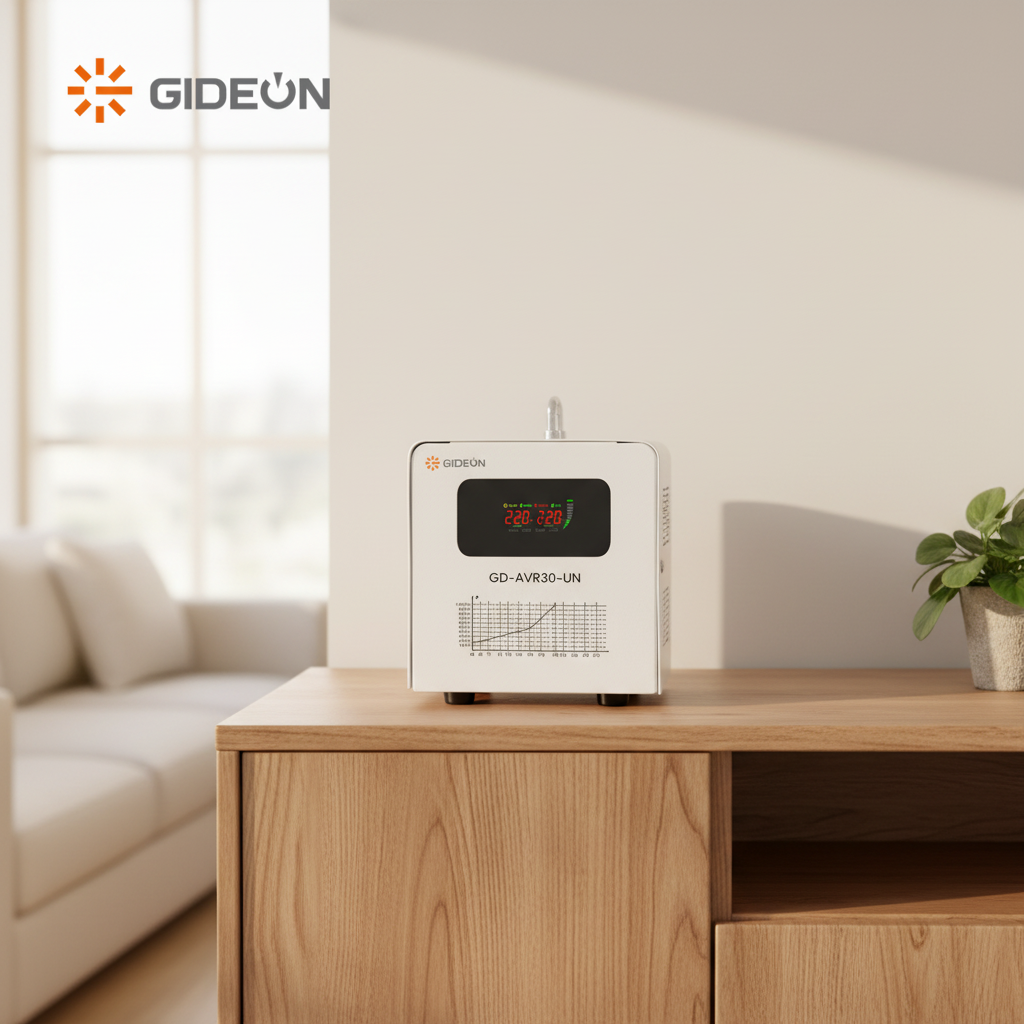
This is the relay-type voltage stabilizer. It embodies practical ingenuity, using a direct mechanical approach to combat grid fluctuations and protect our home electronics.
In an ideal world, household electricity would be a perfectly steady 220V sine wave. In reality, the grid is more like a busy, choppy river. When everyone turns on their air conditioners on a hot evening, the voltage can sag below 200V. Conversely, when a nearby factory shuts down heavy machinery, the voltage can surge past 240V.
These fluctuations are silent threats: an LCD TV's power supply strains under low voltage, a refrigerator's compressor struggles to start, and a computer may crash or lose data during a sudden dip.
The widespread adoption of household appliances highlighted this problem, leading to the rise of a simple, affordable solution: the relay-type voltage stabilizer.
Open up a relay stabilizer, and you'll find its three essential components working in harmony: an autotransformer, an array of relays, and a control circuit board.
At its heart is the autotransformer—a special transformer with a single coil featuring multiple connection points, or "taps." Think of this coil as a road with several exits, each exit (tap) providing a different voltage level, such as 190V, 210V, or 220V.
The relays are the mechanical switches that select which tap is connected to the output. They are controlled by the brain of the system: the control circuit board. When this board detects the input voltage is too low or too high, it commands the corresponding relay to switch to a more appropriate tap.
The beauty of this system is its elegant simplicity. Instead of complex electronic conversion, it physically changes the effective length of the transformer coil to adjust the output voltage.
Let's witness a full voltage correction cycle in slow motion:
Phase 1: Detection
The input voltage drops to 190V. A small sensor transformer detects this instantly and sends the signal to the control board. Within 5 milliseconds, a comparator chip decides: "Voltage is low. Switch to the 210V tap."
Phase 2: Execution - The Break
The relay currently connected (e.g., for the 200V tap) receives the command to open. Its electromagnet disengages, and a spring pulls the silver alloy contacts apart. As they separate, a tiny arc of electricity forms.
Immediately, the arc suppression system acts: magnets stretch the arc, and ceramic plates split it, cooling and extinguishing it in under 3 milliseconds.
This creates a brief, 5-10 millisecond power gap—shorter than a human blink, though some sensitive electronics might notice it.
Phase 3: Execution - The Make
Now, the target relay (for the 210V tap) activates. Its electromagnet pulls the contacts closed. There's a final 1-3 millisecond vibration as the contacts settle firmly into place, minimizing electrical resistance.
In just 15 to 40 milliseconds total, the output voltage has been boosted from 190V to 210V, and your appliances sail on smoothly.
Understanding what a relay stabilizer does well—and what it doesn't—is key to using it effectively.
It excels at protecting robust appliances that aren't overly sensitive to very brief power interruptions or minor voltage steps:
Lighting: For incandescent or LED lights, the "click" and momentary adjustment are usually unnoticeable.
Major Appliances: Refrigerators, air conditioners, and washing machines have motors designed to handle some variance. A stabilizer protects them from the long-term damage of chronic under-voltage.
Consumer Electronics: While modern TVs and audio gear have wide-ranging power supplies, a stabilizer provides a cleaner environment, reducing stress on their internal components.
Consider other solutions for more sensitive equipment:
Computers & Servers: For these, an Uninterruptible Power Supply (UPS) is strongly recommended. It not only stabilizes voltage but also provides crucial backup power during outages to prevent data loss.
Precision Instruments: Medical devices, lab equipment, or high-fidelity audio systems need "clean," noise-free power. The switching action of relays can cause electrical interference, making electronic or online stabilizers a better choice.
Pro Tip for Motor-Driven Appliances: Devices like air conditioners draw a huge surge of current (3-5 times normal) at startup. Always choose a stabilizer with a power rating at least three times higher than the appliance's rated wattage to handle this surge comfortably.
That familiar "click" in the night is more than just a sound. It's the signature of a steadfast, mechanical guardian. In our digital age, it remains a testament to a simple, reliable principle: using robust, physical movement to solve a persistent, invisible problem, quietly ensuring the smooth flow of modern life in countless homes.